What Is a BCM in a Car? Body Control Module Explained
1 October 2026
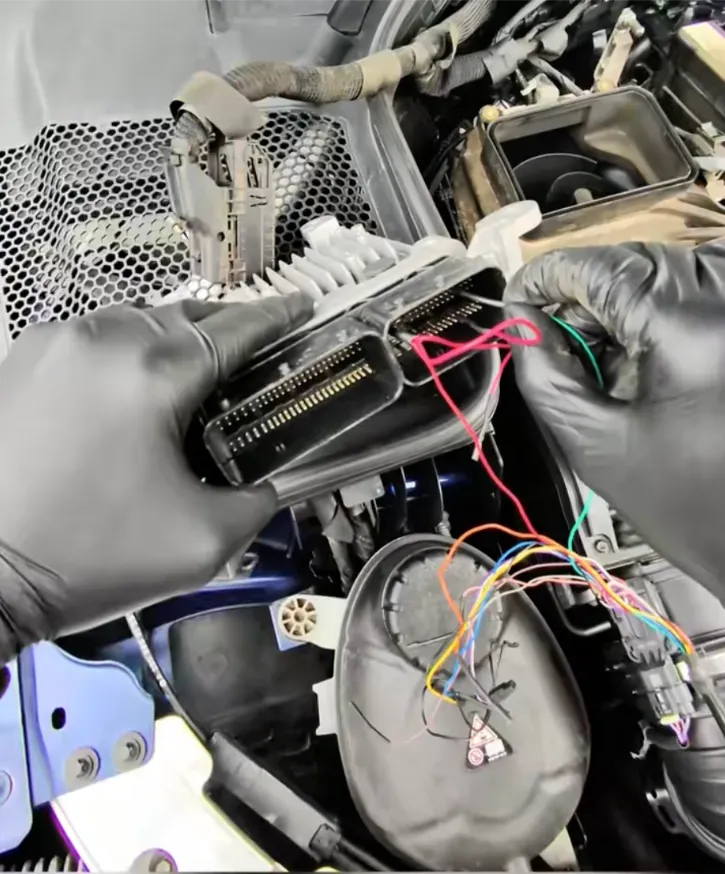
A BCM (body control module), is the small computer that runs your car's electrical comfort and convenience systems: central locking, interior lights, wipers, windows, indicators and the immobiliser. Most people meet the term secondhand. A garage mentions it, or it turns up in a fault code readout, and nobody explains what a BCM actually is.
In this article, learn what a body control module does, what it controls, how it differs from the ECU, and what it costs when yours has gone.
What does BCM stand for, and where is it in your car?
BCM stands for body control module, and it usually lives tucked inside the cabin rather than under the bonnet. You'll also hear the same part called a BCM module, a body module or a body computer, depending on who's talking. None of those names are wrong. They all point at the same box.
Location varies by make and model, but the usual spots are fairly predictable:
- Behind the dashboard, often above or beside the steering column
- In the driver or passenger footwell, bolted to the bulkhead
- Behind a kick panel or a side trim panel
- Next to or built into the interior fuse box
- Occasionally under a seat, on larger saloons and vans
Manufacturers keep it inside the cabin on purpose, away from heat and road salt. Good for the electronics, awkward for access. On some cars you'll have the dash apart and half the trim out before you so much as see the connectors. Not a five minute job, which is why most owners ring a specialist rather than having a go.
What does a BCM do, and what does a BCM control?
The BCM sits between what you do and what the car does with your electrics. Press the lock button on your key and you aren't sending power to four door motors. You're sending a request to the module, and the module decides what happens next.
That's the shift most people miss. Older cars ran a switch, a wire and a relay for every function, so the switch physically carried the current. Modern cars hand nearly all of it to one computer that talks to everything else over the CAN bus. Fewer wires, less weight, far more that depends on a single board behaving itself.
Here's what a body control module typically looks after:
- Central locking. Receives the key or fob signal, drives the door actuators, and handles deadlocking and auto-lock at speed.
- Interior lighting. Courtesy lights, footwell and boot lamps, and the fade-out delay when you shut the door.
- Exterior lighting. Side lights, dipped beam, indicators, hazards and reversing lights, plus bulb failure monitoring.
- Wipers and washers. Intermittent and auto wipe timing, park position and the washer pump.
- Windows and mirrors. One-touch travel, anti-pinch learning, mirror fold and heated mirror elements.
- Heater and climate. Passes blower speed and vent requests between the controls and the climate module.
- Immobiliser. Authenticates the key or fob before the engine is allowed to start.
- Alarm and security. Watches the door, bonnet and boot switches, arms the system and triggers the siren.
- Dashboard warnings. Sends fault and status messages to the instrument cluster.
- CAN bus messaging. Relays messages between the body electrics and the engine, gearbox and airbag modules.
The exact list moves around by manufacturer and model year. Newer cars keep absorbing jobs that used to sit in separate relays and standalone modules, so a 2020 hatchback asks far more of its BCM than a 2008 one did.
And yes, on most modern cars central locking runs straight through the BCM. That's why a locking fault sends so many people down this road in the first place.
BCM vs ECU: which module does what
The ECU runs the engine and the BCM runs the body, and mixing the two up is the single most common confusion on this topic. If it burns fuel, it's the ECU. If it's something you touch, switch or sit in, it's almost certainly the BCM.
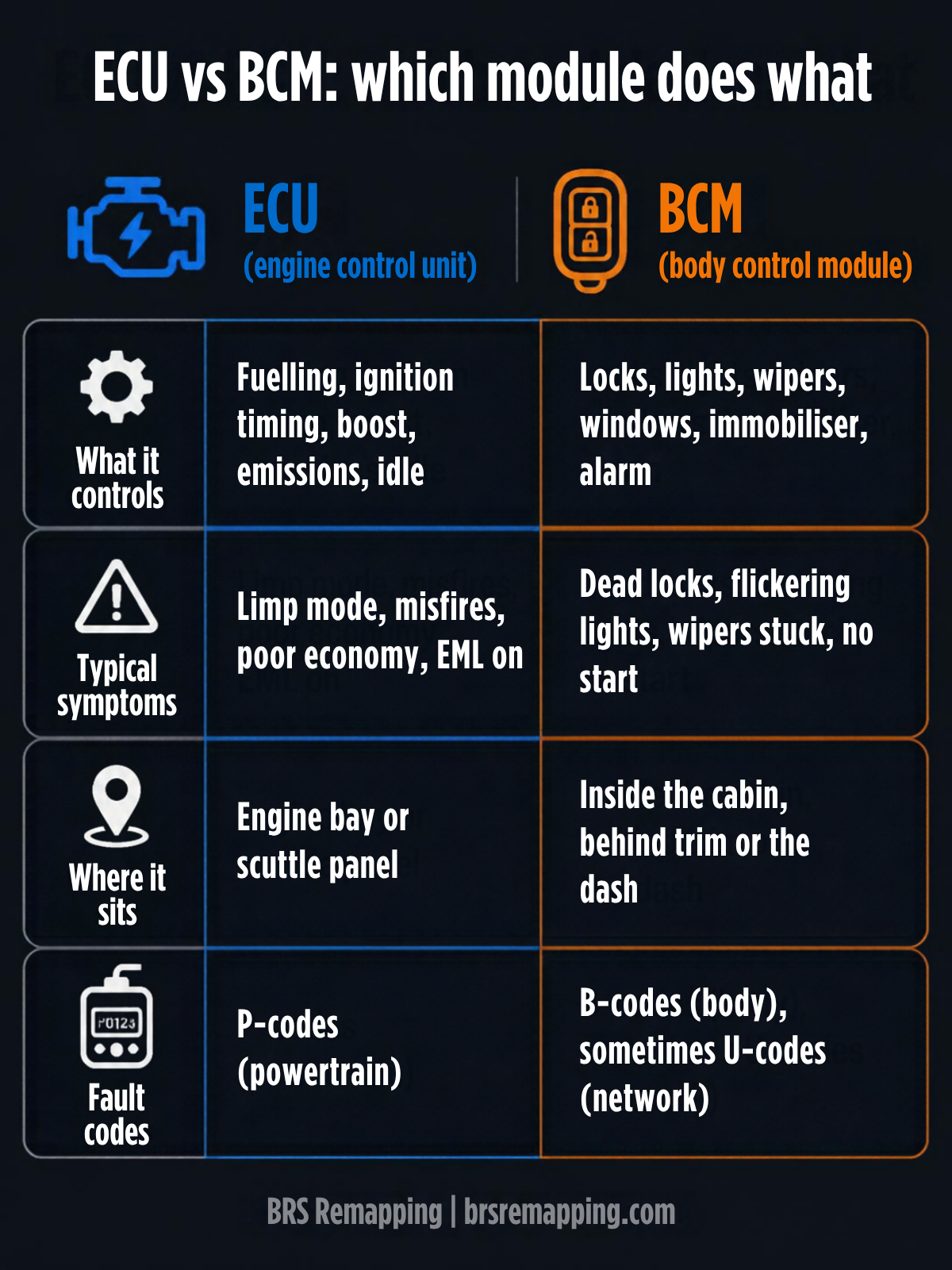
Because these modules share one network, a fault in the BCM can put codes on screen that look like they belong somewhere else entirely. A low voltage message from a failing body module can wake up the engine side and make a healthy ECU look guilty. That's how people end up paying twice. Guessing at the module is the expensive way to do this, and ECU repair in Manchester is a different job with different equipment, so it pays to know which one you're actually dealing with before anything gets unplugged.
How does a body control module affect the way your car drives?
Not much, in the way you're probably thinking. A BCM doesn't touch fuelling or timing, so it won't change your power figure or your mpg the way a remap will. In pure engine performance terms the answer is no.
Driveability is a different question. The immobiliser and key authentication run through this module, so a failed BCM can stop the engine turning over at all. No power fault, no mechanical problem, just a car that won't acknowledge its own key. And a car with dead wipers on a wet Tuesday morning isn't really driveable either, whatever the engine is doing.
So the honest split is this: a BCM affects whether you can use the car, not how quickly it accelerates. If what you're actually after is more power or better economy, that's a remap rather than a module repair, and mobile ECU remapping is the job you want.
What happens when a BCM fails?
Whatever the module was running stops working properly. That's the whole logic of it. Once you know the BCM handles your locks, lights, wipers and immobiliser, a failing one stops being mysterious.
Broadly, faults show up as:
- Electrical items working one day and not the next
- Several unrelated functions going at once, which is the giveaway
- Battery drain overnight with nothing obviously left on
- Warning lights appearing with no mechanical fault behind them
- The car refusing to start despite a healthy battery and starter
It presents much the same across mainstream makes too. A failing body module on a Focus behaves like a failing one on an Astra or a Golf; what changes is the name the manufacturer gives it and how much trim comes off to reach it.
We're deliberately keeping this short, because symptoms deserve more room than one section can give them. If you're already seeing something odd and want the detail, our guide to
BCM fault symptoms, causes and fixes walks through each one properly, including what causes them and what the fix usually involves.
You now know what the module runs and roughly what you're looking at if yours has failed. If you suspect your own BCM has an issue, request a quote for
BCM repair and programming or give us a call on 0161 350 0181. BRS Remapping works mobile across the North West, by post nationwide, or at our Leigh workshop, 9am to 9pm, seven days.
Frequently Asked Questions About Body Control Modules
How do you reset the BCM on a car, and will a reset fix the fault?
Sometimes it helps, but it rarely fixes anything. A reset clears stored codes and can relearn functions like window travel or key recognition. It won't repair a module that has failed physically. On plenty of vehicles a proper reset needs the correct diagnostic tool rather than a battery disconnect.
Does a replacement BCM need programming and VIN coding to your car?
Yes, on almost every modern car. A replacement arrives blank or still coded to another vehicle, so it needs programming and VIN coding before your locks, immobiliser and lighting behave. Skip that step and the car often won't start at all, even with a perfectly healthy module bolted in.
Where can you buy a replacement BCM in the UK, and is a used unit safe to fit?
You can buy them easily enough on eBay or through vehicle dismantlers. The catch is that a used module is normally locked to its donor car, so you pay again for cloning or coding on top. The part price is rarely the full cost of the job.
Is a central locking fault always the BCM?
No. Locking runs through the BCM on most cars, but the fault can just as easily be a door actuator, a flat key fob battery, a latch microswitch or chafed wiring in the door loom. The module is one suspect among several, so test before you replace.
How much does it cost to diagnose a BCM problem at a garage?
Most garages charge a diagnostic fee to pin the fault to a specific module, typically billed as an hour or so of labour. At BRS Remapping we review photographs of the unit and your vehicle registration over WhatsApp first, then tell you honestly whether the job is worth taking further.
Where can you find an auto electrician who repairs BCMs near you?
Look for someone who repairs modules at board level rather than only fitting new ones. BRS Remapping works mobile across Greater Manchester, Cheshire, Merseyside and Lancashire, accepts mail-in units from anywhere in the UK, and takes drop-ins at our Leigh workshop. Call 0161 350 0181.
Where can you buy a replacement BCM in the UK, and is a used unit safe to fit?
You can buy them easily enough on eBay or through vehicle dismantlers. The catch is that a used module is normally locked to its donor car, so you pay again for cloning or coding on top. The part price is rarely the full cost of the job.
Share this post on socials
Recent Blog Posts